Building a Taxonomy of Jobs-Focused Social Enterprise in Australia
A new insights report highlights the key characteristics of Work Integration Social Enterprises in Australia
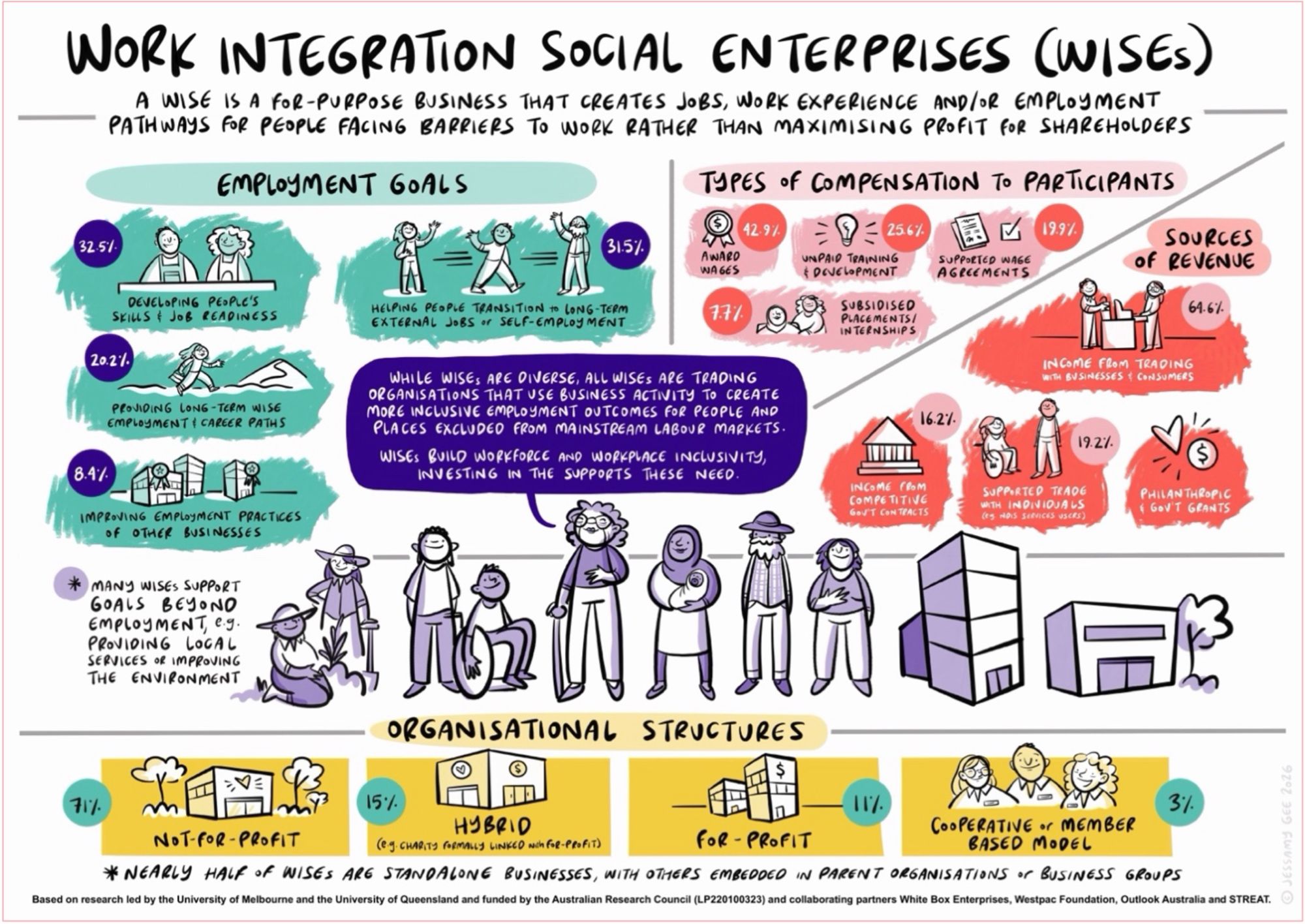
Download, save or print a copy of this infographic
This taxonomy is derived from the project survey and informed by past research led by members of the research team. It should be interpreted as comprehensive but not definitive; a tool for conversation within and beyond the WISE sector. Illustration by Jessamy Gee | Think in Colour.
There are an estimated 12,000 social enterprises operating across Australia. Together, they contribute $21.3 billion to the Australian economy, representing approximately 1% of GDP.
Because of challenges of identification and different methods used in different studies, it is unclear how many are work integration or jobs-focused social enterprises. However, national studies suggest that just over a third of social enterprises in Australia aim to “creat[e] meaningful employment opportunities for people from a specific group”, noting that some social enterprises have multiple purposes.
Work integration social enterprises (WISEs) are diverse, and this diversity is not well-understood by policymakers and funders. With increasing attention being paid to WISE in government reforms to employment services in general and inclusive employment in particular, better understanding of the characteristics of WISE and the diversity of WISE models is needed.
Drawing on a short survey of participants conducted at the 2025 Social Enterprise Jobs Summit hosted by Social Enterprise Australia and White Box Enterprises, this report – the fourth in a series arising from the Australian Research Council Linkage project, Activating Employment Futures Through Work Integration Social Enterprise (WISE) (LP220100323) – presents a taxonomy of the key characteristics and differences of WISE in Australia.
The survey results suggest:
- WISE activities range from building people’s employability, programs that support people to transition into the mainstream labour market, and creating permanent employment within WISE and/or their parent or subsidiary organisations.
- Most WISEs are not-for-profit, but there is a meaningful minority of for-profit businesses and entities that operate as nested/hybrid structures.
- The WISE sector is almost evenly split between standalone enterprises and business units embedded within larger organisations.
- Compensation of people WISE seek to support is mixed. Industrial award wage employment is common, but many WISEs also compensate through unpaid training and supported wage arrangements.
- While some government funding is a common part of WISEs’ revenue mix, this is not universal and comes from multiple levels of government.
Building a Taxonomy of Jobs-Focused Social Enterprise in Australia: The Key Characteristics of Work Integration Social Enterprise (WISE)
Download the Insights Report (PDF)
Download the Insights Report (Word)
Read about the previous Insights Reports
- Scaling the Employment Outcomes of Work Integration Social Enterprises: Perspectives from Practice Experts
- Current Policy Debates and Their Implications for Inclusive Employment Through Social Enterprise: Key Insights From a Rapid Scoping Review
- The Role of Work Integration Social Enterprise in Employment Services Reforms: Perspectives from the Ecosystem
The project is funded by the Australian Research Council Linkage Program (LP220100323) in partnership with White Box Enterprises, Westpac Foundation, Outlook Australia, and STREAT. Academics from the University of Melbourne and the University of Queensland are undertaking the research.
For any enquiries related to this report, please contact Dr Aurora Elmes, Research Fellow at Melbourne Social Equity Institute, elmesa@unimelb.edu.au.