How Can Australia Improve the Inclusivity of its Workforce, the Fairness of its Economic Distribution, and the Nation’s Capacity to Innovate?
A new insights report seeks to share knowledge to scale the employment outcomes of work integration social enterprises.

Image credit: STREAT – Training at STREAT cafe, Collingwood.
Australia’s labour market and employment services have historically under-served people who experience barriers to participation. Work integration social enterprises (WISEs) are for-purpose businesses driven by creating employment and pathways to the open labour market for people and places experiencing barriers.
The Activating Employment Futures Through Work Integration Social Enterprise research project and learning partnership aims to understand how Australia can improve employment outcomes for people experiencing disadvantage through social enterprise.
The first in a series of insights reports arising from the project summarises insights from a rapid scoping review of key policy reform inquiries underway from 2023 to present under the Australian Government.
The report examines the positioning of WISE and implications for scaling their employment outcomes in the Select Committee on Workforce Australia Employment Services, the Royal Commission into Violence, Abuse, Neglect and Exploitation of People with Disability, the National Disability Insurance Scheme Review and the Inquiry into promoting economic dynamism, competition and business formation.
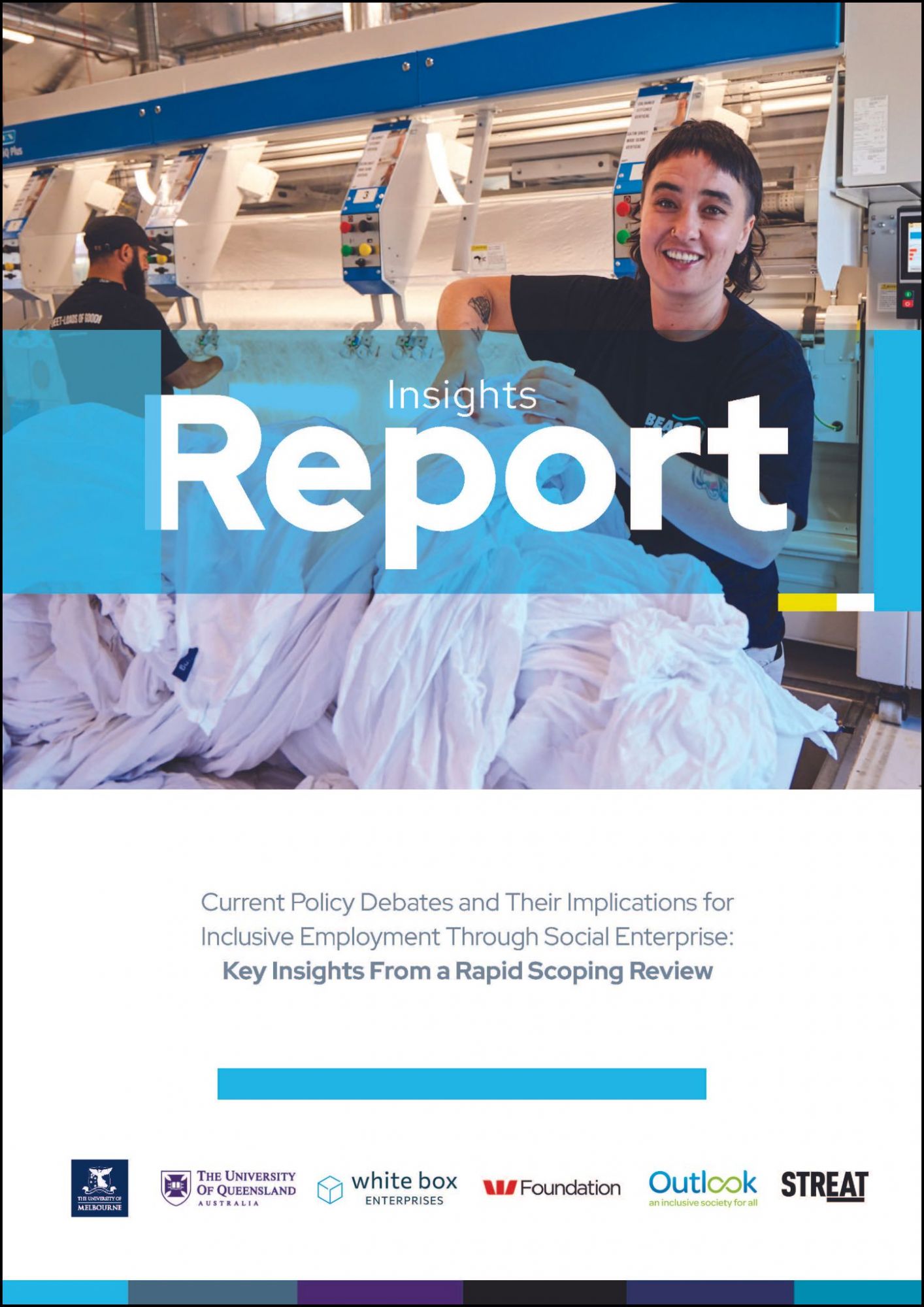
Current Policy Debates and Their Implications for Inclusive Employment Through Social Enterprise: Key Insights From a Rapid Scoping Review
Download the Insights Report (PDF)
Download the Insights Report (Word)
Read about the second Insights Report – The Role of Work Integration Social Enterprise (WISE) in Employment Services Reforms: Perspectives from the Ecosystem
The project is funded by the Australian Research Council Linkage Program (LP220100323) in partnership with White Box Enterprises, Westpac Foundation, Outlook Australia, and STREAT. Academics from the University of Melbourne and the University of Queensland are undertaking the research.
For any enquiries related to this report, please contact Dr Chabel Khan, Research Fellow at Melbourne Social Equity Institute, chabel.khan@unimelb.edu.au.