Working to establish a comprehensive longitudinal dataset and insights about social enterprises
Social enterprises are businesses that exist to produce public or community value, rather than maximise shareholder profits. Existing evidence suggests they contribute over $21 billion to the Australian economy and are positioned to play important roles in current policy reforms in Australia.
Social enterprises, however, experience a long-term challenge as a sector because they are variously regulated and defined, so reliable information about them is fragmented and not routinely available.
The project’s multidisciplinary team, led by Melbourne Social Equity Institute and involving academics from Melbourne Institute of Applied Economics and Social Research, Dilin Duwa Centre for Indigenous Business Leadership and Melbourne Business School’s Centre for Social Purpose Organisations, will work with the Australian Government Department of Social Services and leaders from the social economy ecosystem to establish a comprehensive and accurate dataset and insights about social enterprises and characteristics of the not-for-profit sector.
The work will be carried out using a novel approach which integrates publicly available information with the Business Longitudinal Analysis Data Environment stewarded by the Australian Bureau of Statistics.
Funded by the Australian Government Department of Social Services
The National Social Enterprise Research Project will provide a rigorous picture of Australia’s social enterprise sector, its characteristics, and its contributions and changes over time.
Project establishment
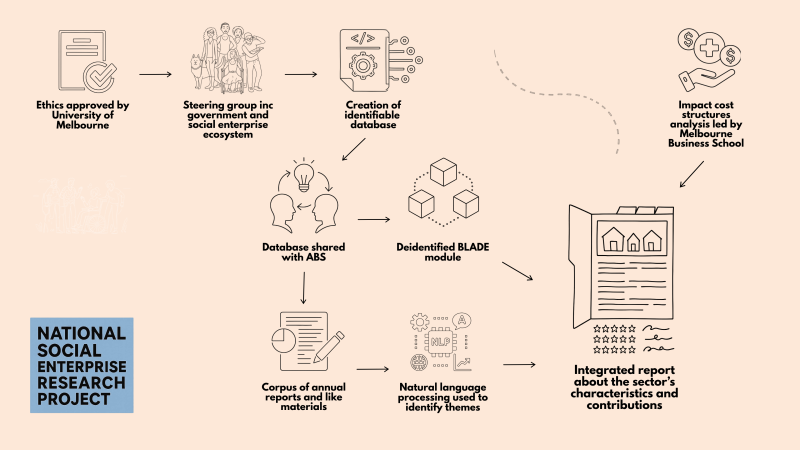
The project set up will involve securing research ethics approvals for the conduct of the work and establishing a project steering group, comprising representatives from government and the social enterprise ecosystem. This group will provide broad guidance to the work, including on how social enterprises are defined and classified for the purposes of the study.
Creation of an identifiable database
The research team will create an identifiable database (the population frame) of all social enterprises that it can find in Australia. This will be done by integrating existing directories, registers and databases, supplemented by additional web searches.
The population frame will be high-level reviewed to ensure that organisations included are consistent with the agreed definitions. It will be organised to provide basic organisational information and to classify social enterprises by their type(s) as agreed with the steering group.
Database shared with ABS and linked to BLADE
The population frame will be provided to the Australian Bureau of Statistics (ABS), who will link it via social enterprises’ Australian Business Numbers to the Business Longitudinal Analysis Data Environment (BLADE) to produce a deidentified Social Enterprise BLADE module.
This will then be available through the ABS DataLab to members of the research team who are approved users to conduct substantial analysis of the sector’s organisational characteristics, such as size, employment creation, financial performance, and geography. The module will also allow the team to analyse workforce dynamics of social enterprises, and some business ownership and governance characteristics. These data will also be used to model economic impacts and industry dynamics of the sector.
Corpus of annual reports
Recent annual reports, evaluations and website information about social enterprises in the population frame will be compiled into a corpus (a structured collection of documents). Machine reading will be used to identify themes about the social purpose activities and impacts of Australian social enterprises based on information in these documents.
Impact cost structures analysis
To respond to a specific need related to current government reforms, insights about the impact cost structures of work integration social enterprises (WISEs) will be developed by members of the team who are leading parallel work in this area.
Project report
The data and analysis created through the project will be integrated into a comprehensive report about Australia’s social enterprise sector. A webinar will be conducted to share project findings in mid 2027. Insights and questions arising from different stages of the project will be shared via this website and with government throughout the process.
The Social Enterprise BLADE module will provide the basis for future research and analysis of developments in the sector.
Funded by the Australian Government Department of Social Services
Project Updates
Wednesday 2 September 2026
From Professor Jo Barraket AM, Project Director
Social enterprises are tricky to define because they are hybrid organisations.
And, there is no one form of incorporation of social enterprises in most jurisdictions. While the great definitional debate can be frustrating for those of us who have been having it for over 20 years, it is important that users of and investors in social enterprise have clarity and that the blurriness of definitions does not encourage 'social washing'.
So, it was great at the first Steering Group meeting of the National Social Enterprise Research Project to achieve quick consensus that the People and Planet First global standards (link below) should be used to define social enterprise for the purpose of this research.
In a separate submission related to Australian employment services reform, colleagues and I have also recommended that governments across departments and our federation adopt a single definition of social enterprise, preferably using these global standards. This would improve public procurement and funding efficiencies, public confidence in what is being resourced, international comparability and the usability of public data arising from government procurement and regulation.
National Social Enterprise Research Project Introductory Webinar
10am – 10.45am (AEST), Thursday 30 July 2026
This webinar provides a short overview of the project approach, expected outputs and timelines. It was a chance for interested people to ask questions of the research team and consider potential applications of the research findings and infrastructure now and in the future.
Links and Resources
Professor Jo Barraket AM, Director, Melbourne Social Equity Institute
Professor Paul Jensen, Chair in Public Policy and Engagement, Melbourne Institute of Applied Economics and Social Research
Dr Trevor Kollmann, Senior Research Fellow, School of Business, Law and Entrepreneurship, Swinburne University
Professor Michelle Evans, Director, Dilin Duwa Centre for Indigenous Business Leadership, Faculty of Business and Economics
Dr Libby Ward-Christie, Director, Centre for Social Purpose Organisations, Melbourne Business School
Dr Li-chia Lo, Research Fellow, Melbourne Social Equity Instittute
For information about this project, please contact: